
A wood-fired hot tub coil is a stainless steel heat exchanger that warms your tub water using nothing but fire and gravity. No electricity, no pump, no gas line. If you have ever wondered how a coil of metal tubing can heat hundreds of gallons of water to soaking temperature, the answer comes down to a natural process called thermosyphon. This guide breaks down exactly how a wood-fired hot tub coil works, step by step, so you understand the physics before you buy or build.
TL;DR: A wood-fired hot tub coil works through thermosyphon. Fire heats the water inside the stainless steel coil, the hot water naturally rises and flows back into the tub, and cooler water from the bottom of the tub is drawn into the coil to replace it. This creates a continuous, pump-free circulation cycle powered only by heat and gravity.
What Is a Wood-Fired Hot Tub Coil?
A wood-fired hot tub coil is a spiraled or looped tube, typically made from food-grade 304 stainless steel, that sits beside or below your tub in a fire pit or wood holder. One end of the coil connects to the lower part of the tub (the cold water intake) and the other end connects to the upper part (the hot water outlet). A fire is built inside or beneath the coil, and the metal tubing absorbs that heat and transfers it directly into the water flowing through it.
The coil functions as a heat exchanger. The fire never touches your tub water directly. Instead, the stainless steel walls of the coil conduct heat from the flames into the water passing through the tubing. Because stainless steel is an excellent heat conductor and resists corrosion at high temperatures, it is the ideal material for this job.
Singema’s coil kits include the heating coil itself along with fire-resistant hoses, tub fittings, a wood holder, an ash collector, and optional accessories like a BBQ grille and rain deflector. You can browse all coil kit models here.
The Core Principle: How Thermosyphon Works
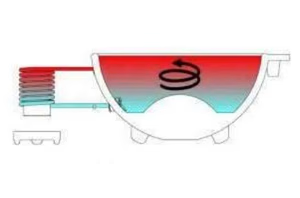
The entire heating process relies on thermosyphon, also called natural convection or gravity circulation. Here is the physics in plain language:
- Fire heats the water inside the coil. As flames surround the stainless steel tubing, the water inside the coil absorbs heat through the metal walls.
- Hot water rises. When water heats up, it expands and becomes less dense. This makes it lighter than the cooler water in the tub, so it naturally rises and flows out the top of the coil.
- Hot water enters the tub. The heated water travels through the outlet hose and flows into the upper part of your tub.
- Cold water is drawn in. As hot water leaves the coil, it creates a pressure difference that pulls cooler, denser water from the bottom of the tub into the coil’s inlet. This cooler water then gets heated, rises, and the cycle repeats.
This creates a steady, silent circulation loop. Hot water continuously flows into the tub while cold water continuously flows into the coil. No pump is needed because the temperature difference itself drives the flow. The greater the temperature difference between the fire and the tub water, the faster the circulation.
You can learn more about the underlying physics on our dedicated page explaining the principle of thermosyphon.
Step-by-Step: How a Wood-Fired Hot Tub Coil Heats Your Tub
1. You Fill the Tub and Connect the Coil
Fill your tub with water from a garden hose or other source. The coil kit connects to the tub using two fire-resistant hoses. The lower hose draws cold water from near the bottom of the tub into the coil inlet. The upper hose returns heated water from the coil outlet into the upper portion of the tub. The system must be primed, meaning both hoses and the coil are filled with water before you light the fire, so the siphon can start.
2. You Build a Fire Inside the Coil
Place kindling and firewood inside the center of the coil, in the wood holder or fire pit area. Light the fire just as you would a campfire. The flames surround the coiled tubing, and the stainless steel walls begin absorbing heat immediately.
3. The Water Inside the Coil Heats Up
Within minutes, the water inside the coil reaches temperatures well above the tub water. The metal tubing transfers heat efficiently because of its large surface area. A coil with more loops or wider tubing exposes more water to heat at once, which is why coil design directly affects heating speed. You can read more about improving coil heater performance through surface area.
4. Thermosyphon Circulation Begins
Once the water inside the coil is hotter than the water in the tub, the density difference kicks in. Hot water rises out of the coil and into the tub. Cold water from the tub floor flows in to replace it. The circulation starts slowly and speeds up as the temperature gap widens.
5. The Tub Reaches Soaking Temperature
Depending on your tub size, insulation, fire intensity, and outside temperature, the water typically reaches 38 to 40 degrees Celsius (100 to 104 degrees Fahrenheit) within 1.5 to 3 hours. Larger tubs take longer. You can speed things up by using dry hardwood, keeping the fire stoked, and minimizing hose length to reduce heat loss between the coil and the tub. Our tips for maximizing coil efficiency cover this in detail.
6. You Maintain the Temperature
Once the tub is hot enough, you reduce the fire to a maintenance level. Add small pieces of wood periodically to hold the temperature where you want it. A stop valve on the hose lets you control or shut off circulation if the water gets too hot, which is a feature included on most Singema coil kit models from the C series and above.
What Makes a Wood-Fired Coil Efficient?
Several design factors determine how fast and how well a coil heats your tub:
- Surface area: More loops of tubing mean more contact between fire and water. Coils with 8 to 12 circles are common, and wider tubing (such as 32mm instead of 25mm) increases water volume in the heat zone.
- Material thickness and grade: 304 food-grade stainless steel balances heat conductivity with corrosion resistance. Thinner walls transfer heat faster but may be less durable over years of use.
- Coil placement: The coil should sit so the fire surrounds as much of the tubing as possible. A fire pit or wood holder that concentrates heat against the coil improves efficiency.
- Hose length and angle: Shorter, straighter hoses between the coil and tub reduce heat loss and flow resistance. Hoses should slope upward from the tub to the coil outlet to help the natural flow.
- Wind protection: A fireguard or wind shield around the coil prevents heat from being blown away and keeps the fire burning steadily even in breezy conditions.
How a Coil Compares to Other Wood-Fired Heating Methods
Not all wood-fired hot tubs use a coil. Here is how the coil approach compares to the main alternative:
| Feature | Coil Heater (External) | Internal Wood Stove |
|---|---|---|
| Placement | Outside the tub, connected by hoses | Mounted inside the tub wall |
| Electricity needed | None (thermosyphon) | None (convection) |
| Tub space used | None, coil is external | Takes up interior space |
| Portability | High, coil kit is movable | Low, stove is fixed |
| Works with any tub | Yes, including stock tanks and barrels | Requires a compatible tub with stove port |
| BBQ cooking | Yes, grill sits over the fire | Usually no |
The coil approach is more versatile because it works with almost any container that holds water. You can convert a stock tank, a wooden barrel, a fiberglass tub, or even a galvanized trough into a wood-fired hot tub. If you are starting from scratch, our guide on building a wood-fired hot tub with a coil kit walks you through the full process.
Frequently Asked Questions
Does a wood-fired hot tub coil need a pump?
No. The coil relies entirely on thermosyphon, which is natural circulation driven by the temperature difference between the heated water in the coil and the cooler water in the tub. Hot water rises and cold water sinks, creating a continuous flow without any mechanical pump or electricity.
How does a wood-fired hot tub circulate water?
Water circulates through a simple loop. Cold water from the bottom of the tub flows through the lower hose into the coil. The fire heats that water inside the coil. The heated water, now less dense, rises and flows out through the upper hose back into the tub. This cycle repeats continuously as long as the fire is burning.
How long does it take to heat a tub with a coil?
Heating time depends on tub volume, insulation, fire intensity, and outside temperature. A typical 500-liter uninsulated tub reaches 40 degrees Celsius in about 1.5 hours. A 1,000-liter insulated tub takes roughly the same. Larger tubs of 1,500 to 2,000 liters may take 2.5 to 3 hours. Using dry hardwood and keeping the fire stoked reduces heating time.
Can I use a wood-fired hot tub coil in winter?
Yes. The coil works in cold weather, though heating times will be longer because more heat is lost to the surrounding air. Models with a freeze drain valve, such as the Singema E4, C4, and F-series kits, let you drain the coil and hoses after use to prevent freezing and cracking. A rain deflector also helps protect the fire in snow or rain.
What are the disadvantages of a wood-fired hot tub coil?
The main drawbacks are heating time (1.5 to 3 hours versus 20 to 30 minutes for electric heaters), the need to manually tend the fire, and the requirement for a supply of dry firewood. Temperature control is less precise than an electric thermostat. However, the tradeoff is zero operating cost, complete off-grid capability, and a more natural soaking experience. For a balanced look, see our post on whether wood-fired hot tubs are worth it.
Is a wood-fired hot tub coil safe?
Yes, when used correctly. The coil and its hoses can get very hot during operation, so avoid touching the metal tubing or hoses while the fire is burning. Always place the coil on a non-flammable surface or use the included ground support and ash pan. Keep children and pets away from the fire area. Our safety guidelines and safe usage guide cover everything you need to know.
Ready to Heat Your Tub With Fire?
A wood-fired hot tub coil is one of the simplest, most reliable off-grid heating methods available. The thermosyphon principle means no moving parts, no electricity, and no ongoing fuel costs beyond firewood. Whether you are heating a stock tank, a cedar barrel, or a custom DIY tub, a stainless steel coil kit gives you hot water anywhere you can build a fire.
Explore Singema’s full range of wood-fired hot tub coil kits, from the basic Model A1 starter kit to the all-weather Model F4 with dual BBQ, freeze protection, and rain deflector. Every kit is built from food-grade 304 stainless steel and ships worldwide.
Not sure which model fits your tub? Read our guide to choosing the right wood-fired hot tub heater coil or contact us for a personalized recommendation.